🤠 Wild West Duel Tips: Read the Tell, Wait for DRAW! & Out-Shoot All 10 Outlaws
There is a particular kind of silence in Wild West Duel that I have not felt in any other game on this site. You are standing in the dust, an outlaw is standing opposite you, and nothing is happening — on purpose. The whole game lives in that stretch of nothing. Because the rule is brutally simple: wait for DRAW!, then TAP anywhere, as fast as you possibly can. Tap a fraction of a second too early and it is a false start, and you have lost the round before your finger finishes moving. That is the entire duel — a quick draw game in the purest sense: one word, one tap, one winner.
What keeps me coming back is the tells, though, not the shooting. Every one of the 10 outlaws has one — a tiny twitch, just before the draw, that gives them away if you are watching closely enough. Learn the twitch and you are not really reacting anymore; you are anticipating, and anticipation is worth more than raw speed. Throw in the mystery HIGH NOON rounds, which pay double bounty, and you have a reaction game online that is half reflexes and half reading people. Here is how to beat all ten of them.
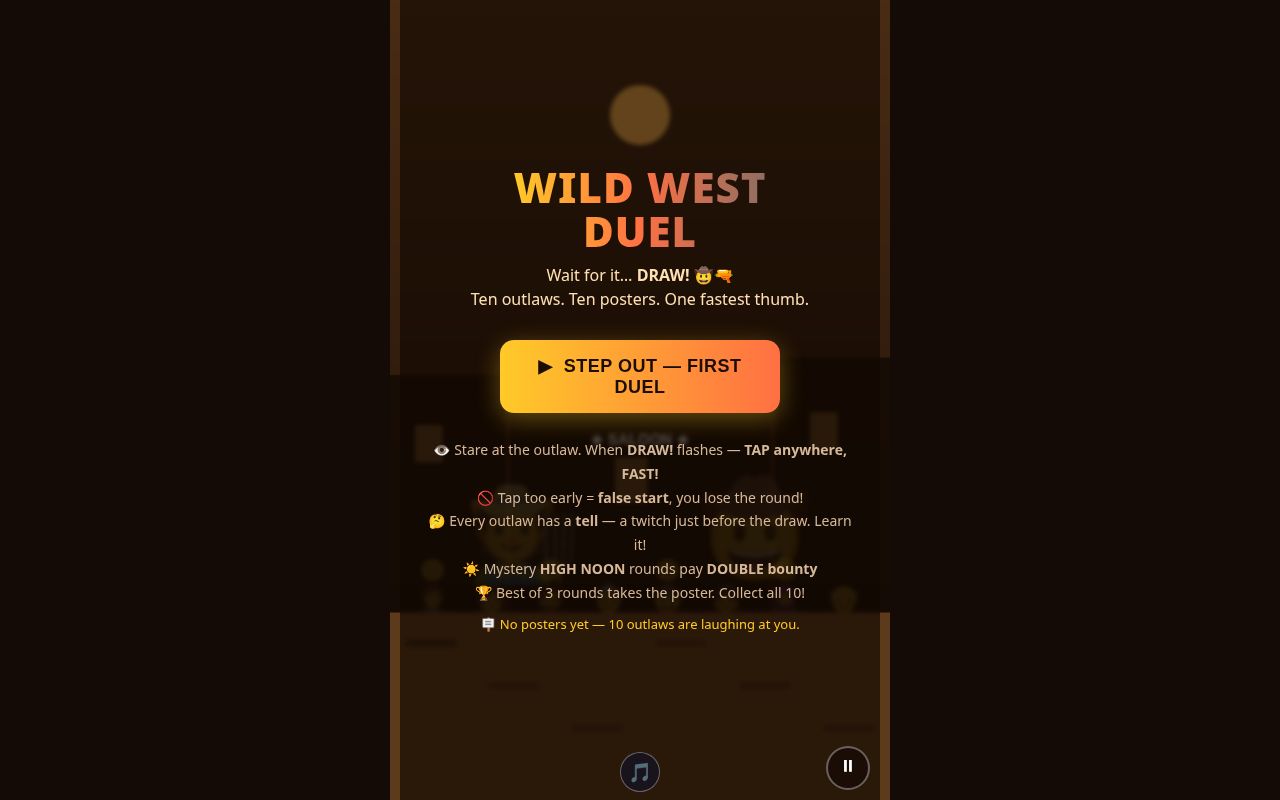
Fresh screenshot from our own game — Wild West Duel. Ten outlaws, ten tells, and one very itchy trigger finger.
The tell comes before the draw — learn to see it
Watch the outlaw, not the word. That is the first thing to unlearn. Your eyes will want to lock onto the middle of the screen, waiting for DRAW! to appear. But by the time you have read the word and told your finger to move, the outlaw has already fired. The tell is faster than the word. It is a small twitch — a shoulder, a hand drifting toward the holster — and once you have seen it a few times you cannot unsee it.
So spend your first duel against a new outlaw just watching. Lose the first round on purpose if you have to, and study the twitch instead of the trigger. Each outlaw's tell is different, and you have to earn that knowledge by standing there and paying attention. After two or three showdowns against the same face you will start firing in time with the twitch rather than after the word — and that is when duels stop feeling like luck.
Your finger is not the problem. Your nerves are
Here is an uncomfortable truth about reaction games: the average human visual reaction time is around 250 milliseconds, a solid one sits in the 220-250ms range, and anything under 200ms is genuinely elite. You cannot train your way to superhuman speed in an afternoon, and you do not need to — the outlaws are not that fast either. What you can fix, right now, is the tension in your hand. A clenched, hovering finger is a slow finger. It trembles, it overcorrects, and worst of all it jumps the gun.
Stay loose. Rest your hand flat, breathe out while you wait, and let the waiting be boring instead of stressful. The pause before DRAW! is random — you cannot rhythm-guess it, so do not try to count a beat and fire on it, because the game will punish that guess with a false start. And lean on any audio cue: sound reaches your brain faster than sight, and in a game measured in milliseconds that head start matters. Calm hands win duels. Tense hands lose them.
High Noon rounds pay double — treat them like they matter
Every so often the duel turns into a mystery HIGH NOON round, and the bounty on offer doubles. There is no warning and no pattern, which is exactly why it catches people out — they play it like any other round, then realise they just threw away twice the money. My advice is the opposite: the moment you realise a round is High Noon, slow your breathing down, not your reactions. The stakes are higher, the false-start punishment is exactly the same, and the temptation to jump early is twice as strong.
The bounty is tracked in dollars, your best bounty too, and the difference between a decent run and a great one is usually one or two High Noon rounds played properly. Win those and the total climbs fast. Lose them to a false start and you have thrown away the best-paying moments in the whole game. Patience pays double here, literally.
Ten posters, best of three, and one more showdown
A duel is best of three rounds, so one bad draw does not end you. Take the poster by winning two of the three, collect the outlaw, and move on to the next wanted face. Collect all ten posters and you have a full gallery of outlaws you out-shot fair and square, each with a tell you learned the hard way.
And when a run finally goes wrong — usually on the outlaw you were most confident about — there is a revive: one more showdown, one last chance. Do not burn it on the first outlaw you lose to. Save it for the late posters, when your bounty is big and the collection is nearly complete. Ten outlaws. Ten tells. One steady hand.
Your Wild West Duel checklist
- Wait for DRAW! — never tap early — a false start loses the round instantly, before you have even drawn.
- Learn each outlaw's tell — every outlaw twitches just before the draw; watch for it and you will fire sooner.
- Stay relaxed while you wait — tension slows your finger, and the pause is random, so don't try to rhythm-guess it.
- Listen for audio cues — sound reaches your brain faster than sight, and milliseconds decide duels.
- Treat High Noon rounds as the big money — mystery rounds pay double bounty, so don't waste them on a greedy early tap.
- Save the revive for late in the run — one more showdown is worth most when your bounty is big and the poster collection is nearly complete.
Ten outlaws, ten tells, one word that decides everything. Wait for DRAW!, trust the twitch you have learned, and keep your hand loose — the west rewards the patient gunslinger, not the quick one. More guides live on the Jollycade blog, and the homepage has the rest of the arcade waiting.
Ready to play? Wild West Duel is free on Jollycade — no download, no sign-up, just click and play on phone or computer.
▶ Play it free now