♠️ How to Play Spades: Rules, Bidding, Nil & Scoring Explained
There's a moment in every spades hand that tells you what kind of player someone is. It's not the first trick, or the big trump play — it's the bid. You look at your thirteen cards, your partner looks at theirs, and both of you have to make a promise out loud: this is how many tricks we're going to win. Get it right and the hand hums along. Get it wrong and you spend the next thirteen tricks watching your own promise fall apart in slow motion. I have been the person who bid 5 on a hand worth 3, and I can confirm the slow motion is real.
Spades is America's great partnership card game — four players, two teams, partners sitting across from each other, one standard 52-card deck, no jokers. Spades Classic USA on Jollycade plays it the classic American way: bid your tricks, follow suit, break spades only when the rules allow, and race to 500. If you've never played, this is the whole game, explained without the jargon fog.
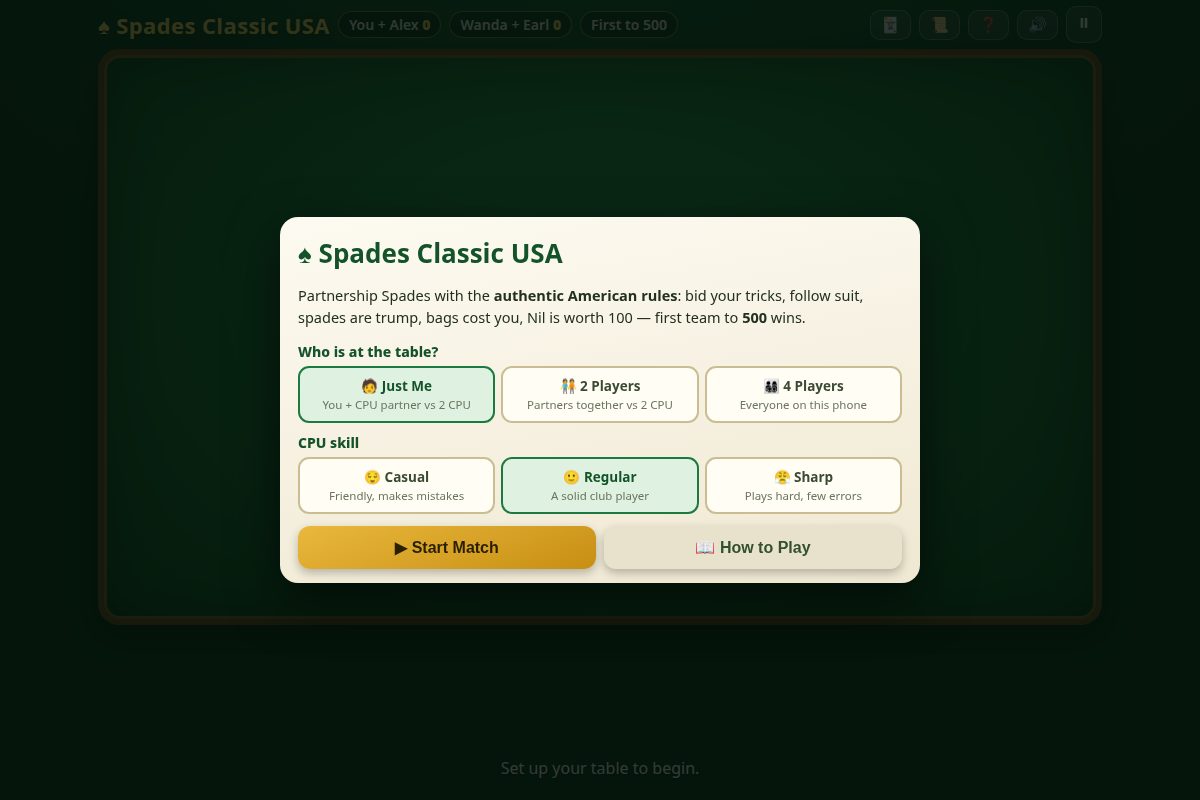
Setting up in Spades Classic USA: you plus a CPU partner against two CPU opponents, first team to 500 wins, with Casual, Regular or Sharp computer skill.
First, the deal and the promise
Every hand starts the same way. All 52 cards are dealt out, thirteen to each player. Then, starting left of the dealer, each player bids — a single number, 0 to 13, saying how many tricks they personally expect to win. Your bid and your partner's bid are added together into your team's contract. If you bid 4 and your partner bids 3, your team has promised 7 of the 13 tricks.
How do you count a hand honestly? Count sure things, not hopes. Aces are tricks. A King with a couple of low cards behind it in the same suit is usually a trick. Long spades — anything past your third spade — are likely tricks too, because spades are trump and trump beats everything. Queens and Jacks in short suits are wishes, not promises. When you're torn between two numbers, bid the lower one. Underbidding costs you a few bags; overbidding costs you the whole contract.
Playing a trick: follow suit, and mind the trump
Once the bidding is done, the player left of the dealer leads the first trick, and play goes clockwise. The rules of a trick are simple and strict: if you hold a card of the suit led, you must follow it. If you can't follow suit, you may play anything — including a spade, which trumps the trick. The highest card of the led suit wins unless a spade appears, in which case the highest spade wins.
One restriction shapes the whole early game: spades cannot be led until they are broken — until someone, unable to follow suit, plays a spade on an earlier trick. Until that moment, spades sit in everyone's hand like loaded dice nobody is allowed to roll. The exception is desperation: if spades are all you have left, you lead them, broken or not.
Scoring: where greed gets punished
Here's where spades gets its teeth. Make your contract and you score 10 points per trick bid — bid 7, take 7 or more, that's 70 points. Miss it and you lose 10 points per trick bid instead: bid 7, take 5, and that's −70. That's why the honest bid matters; the penalty for a broken promise is exactly as big as the reward for keeping one.
Then there are bags. Every trick beyond your contract is an overtrick, or bag, worth just 1 point. Bid 5, win 7, you score 52 — not 70. Bags accumulate across hands: collect ten and your team takes a −100 penalty, count reset. So winning "too well" is a real problem. Good teams learn to duck tricks once their contract is safe, rather than grabbing one more trick nobody needed.
Nil: the 100-point gamble
Bid zero and you've declared Nil: you intend to win no tricks at all that hand. Pull it off and it's worth +100 points. Win even one trick and it's −100. Only bid Nil on a genuinely weak hand — low cards across the suits, no high spades, nothing that will accidentally win. Holding the Ace of Spades? Forget Nil entirely; that card wins whatever trick it lands in.
And Nil is a team event, not a solo stunt. While you're dodging every trick, your partner still has to make their own bid — in our game, the CPU partner is built to protect a Nil, covering tricks you might be forced into and never wasting a trump on a trick you're already winning. If your partner bids Nil, your job flips: win the tricks they can't avoid, and lead suits they're short in. When an opponent bids Nil, do the opposite — lead high cards into their suits and try to force a trick onto them.
Five things that separate decent teams from good ones
- Bid sure tricks, not your hopes. Aces, protected Kings, long spades. Everything else is decoration.
- Count your partner's bid into the hand. If they bid high, play to support it; if they bid Nil, your hand is now a bodyguard job.
- Don't burn spades early. Trump is your safety net. Spend it when it wins something that matters, not on the first trick that looks tempting.
- Duck once the contract is made. Extra tricks are bags, and ten bags cost 100 points. Learn to lose a trick on purpose.
- Play solo first if you're new. In Spades Classic USA, "Just Me" pairs you with a CPU partner against two CPU opponents — a forgiving way to learn bidding before a real partner judges you.
Spades rewards the same two skills over and over: honest counting at bid time, and discipline during play. The cards will sometimes be cruel, but across a race to 500, the team that bids what it can actually win, protects its Nil bidder, and stops grabbing bags it doesn't need will beat the team with better cards and worse judgement. Bid low the first few hands while you learn the rhythm, and don't be surprised when the bidding becomes the part you think about most.
Ready to play? Spades Classic USA is free on Jollycade — no download, no sign-up, just click and play on phone or computer.
▶ Play it free now