✦ Word Cross America Tips: Bonus Squares, the +50 Bingo & Building Words That Score
There is a specific, quiet thrill to a crossword tile game that no other puzzle quite matches: seven letters in your rack, a board full of other people's words, and the sudden realisation that your tiles can do something nobody else saw. Word Cross America is the classic American crossword tile game, in both its beloved forms at once — the board game you grew up with and the phone favourite — with 100 tiles, a 7-tile rack, and bonus squares scattered across the board like buried treasure. Two to four seats on one phone, every seat a person or the computer, racks kept secret as the phone gets passed around. It's the game night that fits in your pocket.
I'll be honest: my first game was humbling. I played the longest words I could find, felt very clever about it, and lost by a wide margin to a computer opponent who played short, ugly little words on bonus squares. That game taught me the lesson this whole guide is built on: in Word Cross America, a word's length matters far less than where you put it. A three-letter word on a Triple Word square beats a seven-letter word in the middle of nowhere, every single time.
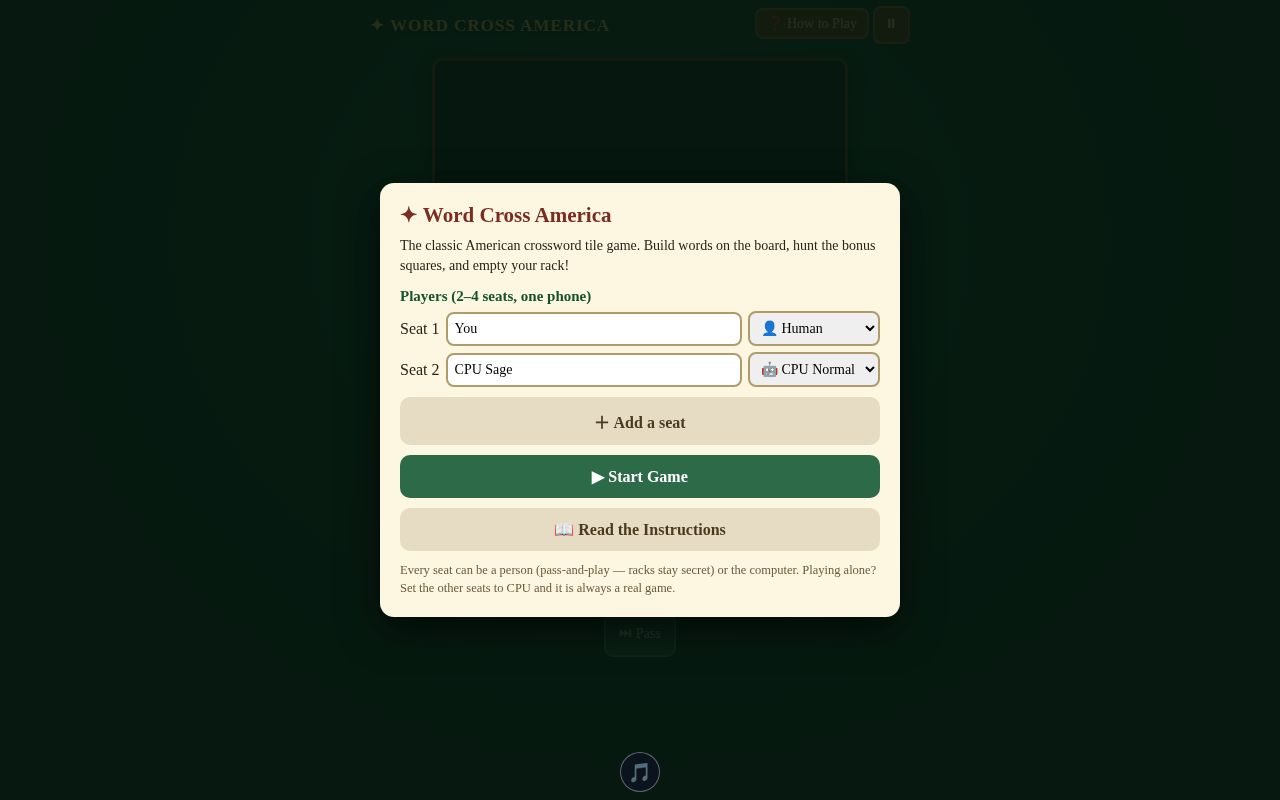
Fresh screenshot from our own game — Word Cross America setup. Two to four seats on one phone, every seat a person or the computer.
The bonus squares are the game — learn the map
DL and TL boost a single letter. DW and TW multiply the whole word. That one sentence is worth more than any vocabulary list, because the board is a landscape of multipliers and the players who win are the ones who navigate it. A high-value letter — a Q, a Z, a J, an X — sitting on a Triple Letter square is a small fortune. A modest word stretched across a Triple Word square is a bigger one. Before you play any word, scan the board for the nearest bonus square and ask: can I reach it? Can I reach it with a letter worth boosting?
And the reverse matters just as much. Every bonus square you leave open is a bonus square your opponent can use next turn. If you can't reach a Triple Word square yourself, think twice about building a word that ends right next to it — you may have just handed your rival the platform for the biggest play of the game. The board is shared territory, and every word you place changes the map for everyone.
The +50 bingo: play all seven tiles
Play all 7 tiles from your rack in a single turn and you earn a +50 bingo bonus on top of the word's score. Fifty points, free, for using everything you've got. It's the single biggest swing in the game, and it changes how you should think about your rack. Most players treat a rack full of awkward letters as bad luck. The bingo hunter treats it as a puzzle: what seven-letter word can I build from this mess? Common letter pairs are your friends here — the little two-letter combinations like ER, ED, ING, and TION that turn a jumble into a word. And the blank tile, which can stand for any letter, is the most valuable thing you'll ever draw: save it for a bingo attempt, not for a three-letter filler word.
One practical habit: before you play a word, glance at your remaining tiles and ask whether holding one more turn could complete a bingo. Sometimes the right play is to wait. A 20-point word now is worse than a 60-point bingo next turn — but only if the bingo is real. Don't chase ghosts. If you can't see the word, play the word you have.
Short words win games (yes, really)
Here's the thing my humbling first game taught me. Cross-words — the little two and three-letter words your main word creates where it crosses existing tiles — score too, and they score on the same bonuses. A short word placed cleverly can create two or three cross-words at once, each one collecting its own letter bonuses, and suddenly a four-letter play is worth more than a seven-letter one. The best players in this game aren't the ones with the biggest vocabulary. They're the ones who see the board as a grid of opportunities, not a blank page for showing off.
So learn your short words. Two-letter words are the skeleton key of this game: they let you play parallel to existing words, hook onto a single letter, and squeeze points out of the tightest corners of the board. You don't need a dictionary in your head — you need a handful of flexible little words and the habit of looking for the parallel play before the long one.
Exchange is a turn — spend it wisely
Stuck with a rack full of vowels, or four I's and no consonant in sight? You can exchange tiles — but it costs your whole turn, and the exchanged tiles go back in the bag. That's a real price, so treat exchanging as a decision, not a reflex. Exchange when your rack is genuinely unplayable, not when it's merely uninspiring — an uninspiring rack can still make a short word on a bonus square, and a short word on a bonus square beats a lost turn. And never exchange your only high-value letter out of impatience. The Q that looks useless now is the Q that lands on a Triple Letter square three turns from now.
Your wordsmith's checklist
- Play for the bonus squares, not the long words — DL/TL boost letters, DW/TW multiply whole words; position beats length.
- Hunt the +50 bingo — all 7 tiles in one turn; save the blank for a bingo attempt, not a filler word.
- Build cross-words — short parallel plays that create two or three scoring words at once often outscore long words.
- Don't gift the Triple Word — never end a word next to an open TW square your opponent can use.
- Exchange only when the rack is truly stuck — it costs a whole turn; a short word on a bonus square is usually better.
- Use your 3 hints when you're genuinely stuck — a hint that finds a bingo is worth more than a hint spent on a 12-point word.
- Shuffle your rack — rearranging the tiles often reveals a word your eyes were skipping over.
Word Cross America rewards the player who sees the board, not just the rack — the bonus squares, the crosses, the bingo hiding in seven awkward letters. Play the map, save the blank, and when the seven tiles line up, take your fifty points and enjoy it. More guides like this live on the Jollycade blog, and the homepage has the rest of the arcade waiting. Your move.
Ready to play? Word Cross America is free on Jollycade — no download, no sign-up, just click and play on phone or computer.
▶ Play it free now