🥋 Street Dojo Clash Tips: Time the Parry, Cash the Counter & Take Down Master Hiro
Most fighting games ask you to attack well. Street Dojo Clash asks you to defend beautifully — and then punishes your rival for ever having thrown that punch. This is a street fighter parry game built around one perfect idea: tap PARRY the instant a strike is about to land, take zero damage, and your next hit deals +50% inside the counter window. Get it right and the whole match flips. Get it wrong and you're standing there posing, defenceless, while your rival says thank you very much.
The shape of the game is classic: win 2 rounds before the 60-second clock runs out, climb all 9 ladder stages — a new street, a new rival, a new unique power every time — and beat Master Hiro himself at the end. Eight fighters, eight one-of-a-kind powers, and a Tower of 50 stages waiting behind the ladder for anyone who thinks they've mastered it.
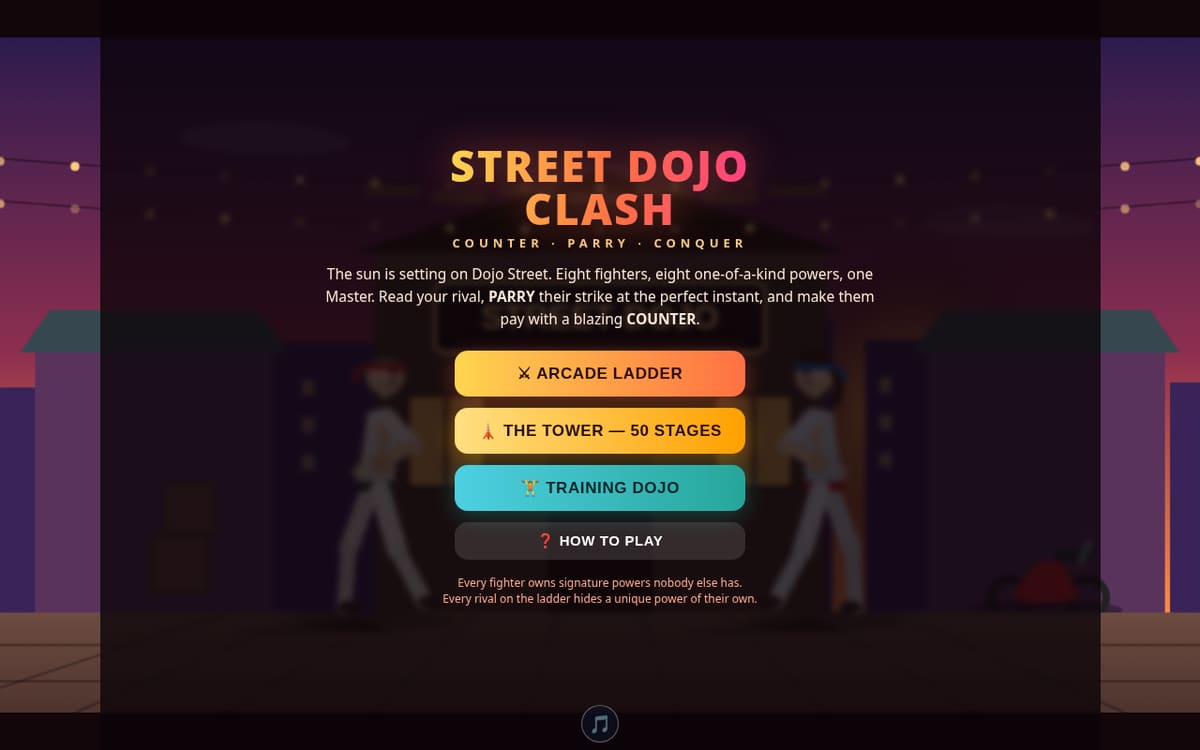
Fresh screenshot from our own game — Street Dojo Clash. Counter, parry, conquer — on a street where the sun is setting.
The parry is 10 frames. Respect the window.
Let's be honest about what the parry is: a 10-frame window, tapped with U on keyboard or the teal PARRY button on touch screens. That's not a lot of time, and it's exactly why the parry feels so good when it lands — a flash of light, zero damage, and your rival standing wide open while your fists glow with the counter window.
Here's what took me too long to learn: you don't parry by reacting to the punch. You parry by reading the rival. Every fighter has a rhythm — a jab, a pause, a heavy swing — and the parry lands when you press it on the beat you already expected, not the one you just saw. Watch two exchanges before you try your first parry. Learn the timing of their favourite attack, then press PARRY a heartbeat before it arrives. When the COUNTER! flash pops up, that's the game telling you it worked.
And the warning the game gives you is real: parry too early and you're left posing, defenceless. Worse, the masters on the high ladder will bait your parry — throw a swing they want you to parry, then punish the pose. Don't bite on every swing. Parry the attacks you've actually read, not the ones you're hoping for.
Guard is the parry's patient older sibling
Before the parry, there is the guard — hold I, or hold away from your rival, and you block with only small chip damage. Guard is what you do while you're learning someone's rhythm. It's also what you do when you're not sure: a blocked heavy hurts a little, a whiffed parry hurts a lot.
The smart rhythm of a match goes like this: guard the first exchange, learn the timing, parry the second, cash the counter. Some powers chip harder or break guard entirely, so respect the ones that do — but for most of the ladder, a player who guards patiently and parries selectively will beat a player who parries everything and prays.
Your counter window is a cheque — cash it immediately
After a successful parry, your fists glow and your next hit inside the counter window deals +50% damage. That window does not wait around. The mistake is landing the parry and then hesitating — admiring the flash, thinking about which move to use — while the window quietly closes.
Decide your punish before the parry. For most fighters, the simplest answer is best: a heavy or a launcher. Launchers (down + Heavy, the Rising Upper, or your fighter's own launching power) pop rivals into the air, and airborne rivals can be juggled — but juggles are capped at 4 hits, so make them count. A parry into a launcher into a short juggle is the highest-value sequence in the game, and it's worth drilling in the Training Dojo until it's automatic.
Three powers, one super, zero sharing
Every fighter has 3 signature powers fired by button sequences — something like forward-forward + Punch — plus a unique SUPER at full meter (down, down-forward, down-forward + Heavy). No two fighters share a power, and every rival on the ladder hides a unique power of their own. That last part matters more than it sounds: the ladder isn't just nine harder fights, it's nine different problems.
Learn your own three powers in Training or from the move list in pause, but spend just as much time learning what the rival's power does. The stage intro card tells you — read it. A rival whose power breaks guard needs a completely different answer than one whose power is a projectile. And your super meter fills as you hit, block and get hit, so by the second round you usually have it — save it for the moment your rival is open, not the moment you're frustrated.
Your Street Dojo Clash checklist
- Read the rhythm before you parry — watch two exchanges, then press PARRY on the beat you expect.
- Never parry on hope — a whiffed parry leaves you posing, and high-ladder masters bait it.
- Guard while you learn — hold I or away; chip damage beats a punished parry every time.
- Decide your punish before the parry — parry into launcher into a 4-hit juggle is the money sequence.
- Learn your 3 signature powers — and read every rival's intro card before the round starts.
- Save your super for an open rival — full meter (down, down-forward, down-forward + Heavy) is a finisher, not a panic button.
Street Dojo Clash is the rare fighting game where the best moment isn't landing a huge combo — it's the half-second of silence after a perfect parry, when the flash fades and your rival realises they just handed you the round. Master Hiro at stage 9 is waiting to test whether you actually learned that, and the Tower's 50 stages are waiting behind him with bosses at 10, 20, 30, 40 and 50. Take your time in the Training Dojo. The parry will wait. Your rival won't. More guides live on the Jollycade blog, and the homepage has the rest of the arcade waiting.
Ready to play? Street Dojo Clash is free on Jollycade — no download, no sign-up, just click and play on phone or computer.
▶ Play it free now