🚂 Railway Empire Builder Tips: Lay Smart Track, Grow Towns & Beat Every Contract
There is something deeply satisfying about watching a town grow because your trains keep showing up. Railway Empire Builder is a train tycoon game built on that exact feeling: you lay the track, you buy the trains, you set the routes, and the towns on your line get busier, richer, and hungrier for more service. Then the contract clock reminds you that all of this has a deadline.
Each contract gives you twelve months and a delivery target — contract one wants forty passengers, and freight joins the job later. Hit the target before the months run out and the contract is yours. Miss it, and you are explaining yourself to an investor. The game is generous with second chances and ruthless about wasted money, which is a fair trade.
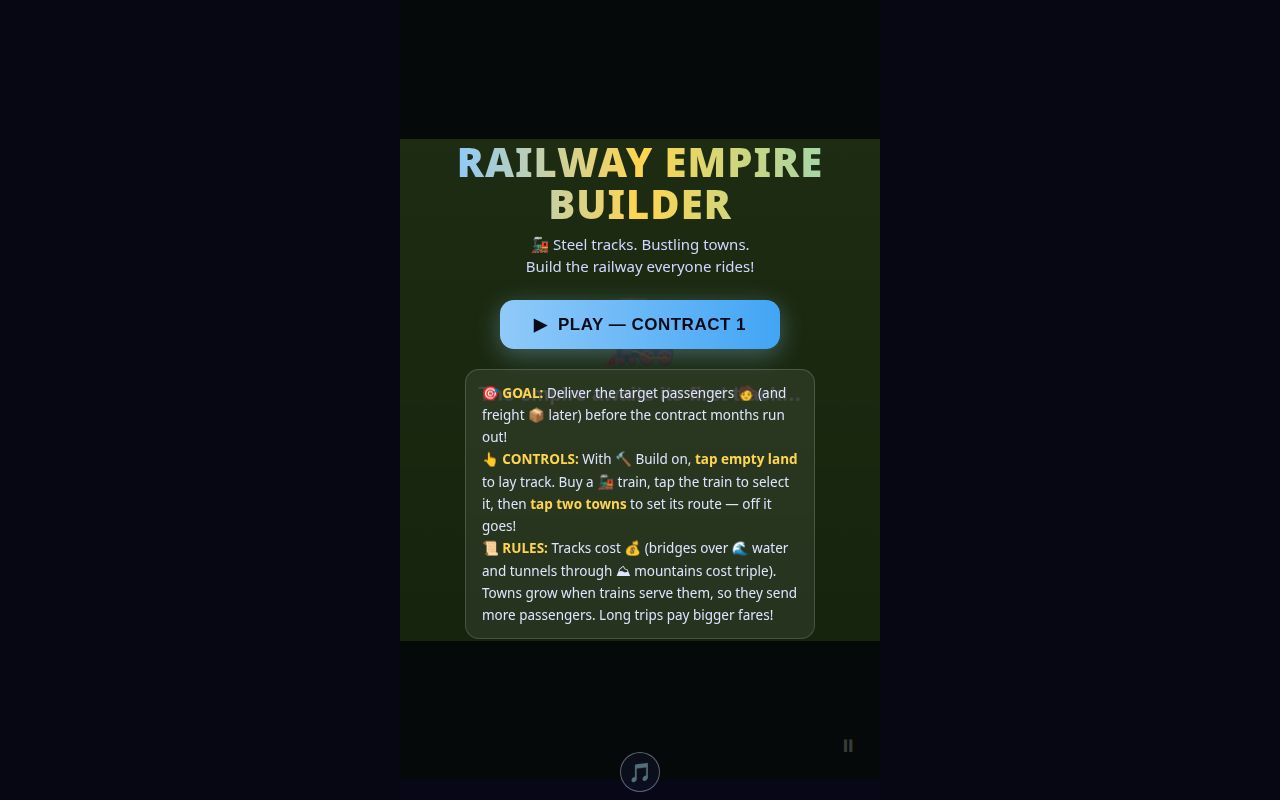
Fresh screenshot from our own game — Railway Empire Builder. Steel tracks, bustling towns, one growing empire.
Track is money. Spend it where it earns
Every tile of track costs gold, and the costs are not equal. Flat land is cheap. Bridges over water and tunnels through mountains cost triple, which means a "shortcut" through a mountain range can cost more than the long way around it ever would. Before you lay a single tile, look at the map and ask whether the expensive crossing actually earns its keep.
The habit that saves most new builders: lay the cheap line first and upgrade later. A short, flat route between two close towns starts paying fares on day one, and those fares fund the expensive bridge you actually need. The players who build the perfect network first and earn money second are usually the ones staring at an empty treasury in month four.
Two towns, one train, one route — keep it simple
Setting a route could not be simpler: buy a train, tap it to select it, then tap two towns. Off it goes, back and forth, carrying passengers and earning fares. The temptation is to buy three trains before the first one has earned a coin. Do not. One train on a good route teaches you what a good route looks like — which towns are busy, which trips pay best, where the bottlenecks are — and that lesson is worth more than three trains running blind.
Long trips pay bigger fares, so a train that runs the length of the map earns more per journey than one hopping between neighbours. But long trips also take longer, so the fares arrive slower. The sweet spot, in my experience, is a route long enough to pay well and short enough that the train is always moving, always earning, never sitting idle at a terminus waiting for passengers who are not coming.
Towns grow when you serve them — so serve them
Here is the mechanic that makes the whole game click: towns grow when trains serve them. A town your trains visit regularly sends more passengers, which means more fares, which means more money for more trains, which means the town grows further. It is a virtuous circle, and it starts with showing up.
That is why abandoning a route is so costly. A town you stop serving stops growing, and a town that stops growing stops sending passengers. If a route is underperforming, fix it — add a train, shorten the line, connect it to a busier town — but do not just leave it. In this game, neglect is the most expensive decision you can make, because it costs you the growth you cannot see.
The contract clock is the real opponent
Twelve months sounds generous until month eight arrives and you are twelve passengers short. The contract target is not a suggestion, and the months do not pause while you admire your network. Check the target every time you open the game: how many delivered, how many to go, how many months left. If the math does not work, change something now — a second train on your busiest route, a new town connected, a fare-earning long run — not in month eleven.
And if a contract does fail, take the investor bailout and learn from it. The bailout is not a punishment, it is the game telling you the plan needed more trains, or cheaper track, or earlier expansion. The next contract starts with that lesson already paid for.
Your Railway Empire Builder checklist
- Lay cheap track first — bridges and tunnels cost triple, so earn fares before you build the expensive crossing.
- Start with one train on one good route — learn what earns before you buy a fleet.
- Serve towns regularly — towns grow when trains show up, and growing towns send more passengers.
- Favour long trips for bigger fares — but keep trains moving; an idle train earns nothing.
- Check the contract math constantly — delivered vs target vs months left, and act early.
- Fix underperforming routes, don't abandon them — neglect costs you the growth you can't see.
Twelve months, a handful of towns, and a network that grows because you keep showing up. Railway Empire Builder is a tycoon game that rewards patience and punishes waste, and there is no better feeling than watching a town you connected boom into a busy hub. More guides live on the Jollycade blog, and the homepage has the rest of the arcade waiting.
Ready to play? Railway Empire Builder is free on Jollycade — no download, no sign-up, just click and play on phone or computer.
▶ Play it free now