🃏 How to Play Solitaire: Klondike Rules, Setup & Winning Strategy
I learned solitaire the way most people did — watching someone play it on a computer during a slow afternoon, convinced for a solid ten minutes that it was basically just "put the cards in order." Then I tried it myself, got stuck with three Kings and nowhere to put them, and realised the game had been quietly laughing at me the whole time.
When someone says "solitaire" in America, they almost always mean Klondike. That's the version in Solitaire Classic USA on Jollycade, played exactly the way it's played across the USA — no house-rule twists, no weird variants smuggled in. Here's how it works, and how to stop losing deals you should have won.
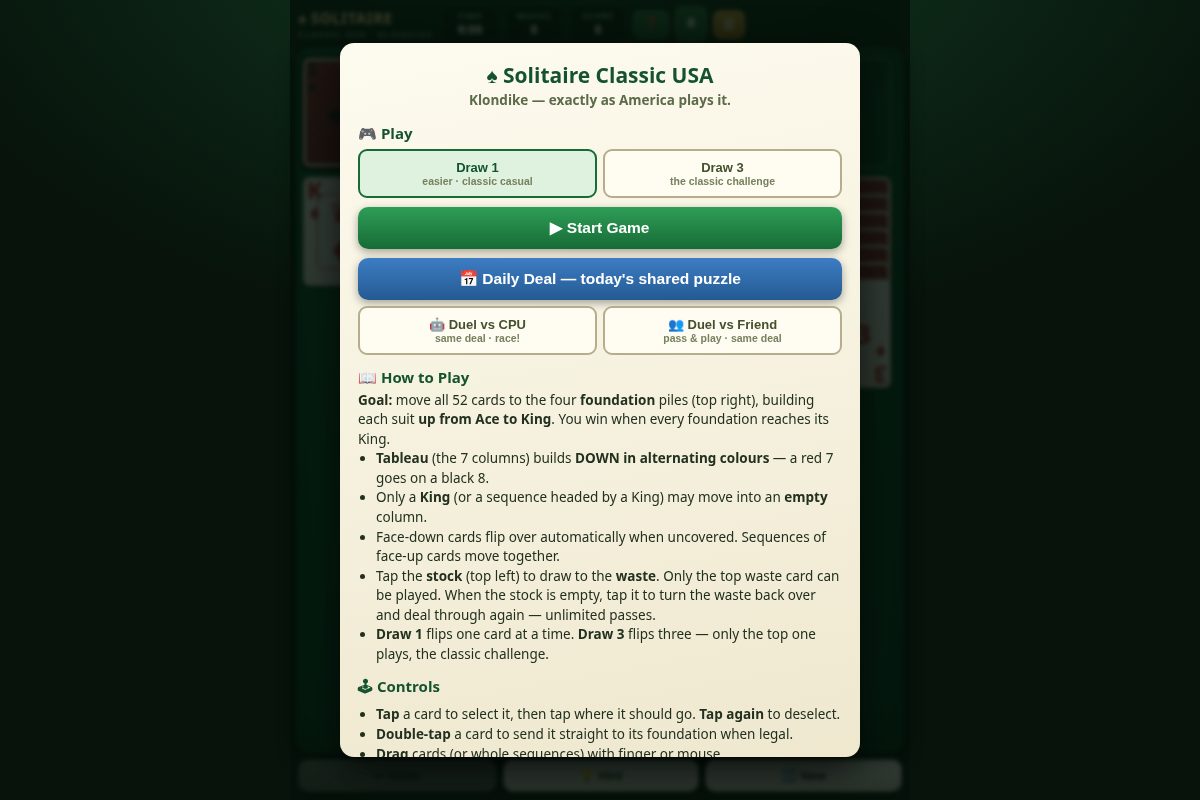
The start screen in Solitaire Classic USA: Draw 1 for a gentler game, Draw 3 for the classic challenge, plus a Daily Deal and Duel modes.
The table, in plain English
One standard 52-card deck, no jokers. The game deals seven columns — called the tableau — in a staircase: one card in the first column, two in the second, all the way up to seven in the last. Only the bottom card of each column starts face up; the other 21 sit face down, waiting to be uncovered. The remaining 24 cards form the stock, the pile you draw from when you're stuck.
Above the tableau sit four empty foundation piles, one per suit. Your whole job is getting all 52 cards up there. A foundation starts with its Ace and builds upward in suit — Ace, 2, 3, all the way to King. When the fourth King lands, the cards cascade and you've won. That's it. Everything else is the traffic jam in between.
The only four moves you'll ever make
Once these click, you know the game. First, build the tableau down in alternating colours: a red 7 goes on a black 8, a black Queen goes on a red King, and so on. Second, build the foundations up in suit, as above. Third, move a properly ordered run as one piece — grab the top card of the run and the rest follows. Fourth, tap the stock to draw into the waste pile, where only the top card can be played.
And then there's the rule that ruins beginners' days: only a King — or a sequence headed by a King — can move into an empty column. I can't count how many games I've seen people clear a column triumphantly, then discover they have no King available and stare at a hole they can't use for the rest of the deal. Never empty a column unless you already know what's going into it.
Draw 1 or Draw 3? Pick honestly
This one setting changes the game more than anything else on the board. In Draw 1, you flip one card at a time, so every stock card is eventually reachable. It's forgiving, it's the right place to learn, and there's no shame in it — plenty of experienced players warm up here. In Draw 3, three cards flip at once and only the top one is playable, which means the other two sit buried until you cycle the whole stock again. Same rules, same deal, much tighter margins. If you're still learning the rhythm of the game, start Draw 1 and switch when Draw 1 starts feeling easy rather than lucky.
One more comfort in our version: the stock recycles with unlimited passes, and there's unlimited undo. Undo isn't cheating here — it's how you learn. Play a move, watch what it uncovers, undo it, try the other option. That's the fastest way to develop the instinct for which move actually helps.
What good players do differently
After enough games, a pattern shows up. Good players don't chase the foundations; they chase face-down cards. Every hidden card is information you don't have yet, and flipping one is almost always worth more than sending a low card upstairs. The classic beginner mistake is firing every Ace and 2 to the foundations the second they appear — then discovering that same 2 was the only card that could sit under a 3 in the tableau and unlock a whole column.
So the order that works, most of the time: uncover face-down cards first, especially in the longest columns; hold low cards in the tableau if they're doing useful work there; and scan the whole board before drawing from the stock, because a stock draw you didn't need is a card buried for another full cycle. When two moves look equal, take the one that opens a column or frees a King. And when the board goes quiet — no moves anywhere — that's not failure, that's the game telling you to cycle the stock and look again with fresh cards.
A few habits worth stealing
- Don't empty a column on hope. Check for a King first. No King, no clearance.
- Keep Aces and 2s in play when they matter. Foundations can wait a move; a blocked column can't always be fixed.
- Attack the longest columns. The column with five face-down cards hides more future moves than the one with a single card.
- Use undo as a classroom, not a crutch. Try the bold move, see the result, rewind, and remember why it failed.
- Try the Daily Deal. Everyone gets the same puzzle that day, which makes comparing scores with a friend actually mean something.
- Race someone in Duel mode. Same deal, live race against the CPU — or pass-and-play with a friend on one phone — and suddenly every wasted move stings properly.
Here's the honest truth about solitaire: some deals genuinely can't be won, no matter how well you play. Don't let that bother you. The skill isn't winning every deal — it's winning the winnable ones, and recognising the difference comes with practice. Play a few deals in Draw 1, get comfortable with the alternating-colour rhythm, and when you start clearing boards on purpose instead of by accident, step up to Draw 3.
Ready to play? Solitaire Classic USA is free on Jollycade — no download, no sign-up, just click and play on phone or computer.
▶ Play it free now