🚂 How to Play Mexican Train Dominoes: Rules, Setup & Scoring
Every family has a game that comes out when the phones go down. In a lot of American homes, that game is Mexican Train — a domino game that's easy enough to teach in five minutes and deep enough that somebody at the table is always quietly plotting. If you've only ever played regular dominoes, where everyone builds one shared line, Mexican Train will feel familiar for about thirty seconds and then pleasantly strange. Here's the whole thing, the way it's actually played, with no house-rule fog.
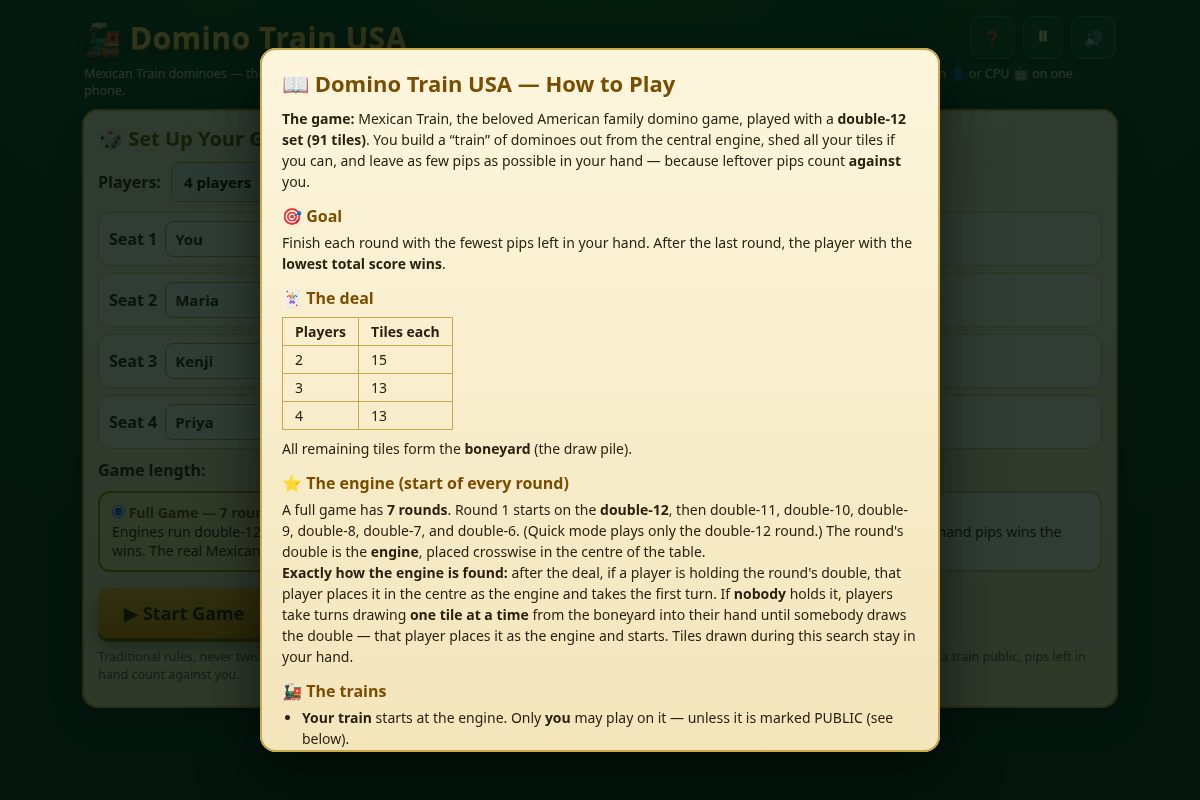
Domino Train USA's own rules screen — the same traditional rules this guide explains.
What You're Playing With
Mexican Train uses a double-12 domino set — 91 tiles, numbered 0 to 12 on each end. Two to four players is the sweet spot (the game stretches to eight with a full set, but the table gets crowded). Each player builds their own "train" of dominoes outward from a central starting tile, and there's one shared train — the Mexican Train — that anyone can play on. The goal of each round is beautifully simple: finish with the fewest pips (dots) left in your hand. After the last round, the lowest total score wins. Low score good, high score bad — that's the one thing new players always get backwards, so pin it down first.
Setting Up: The Engine and the Deal
A full game runs 7 rounds, and each round starts on a different "engine" — the double that sits crosswise in the centre of the table. Round 1 starts on the double-12, then double-11, double-10, and so on down to double-6. (Short on time? A single double-12 round works fine as a quick game, and that's exactly what the Quick Round mode in Domino Train USA does.)
The deal depends on player count: 15 tiles each with 2 players, 13 each with 3 or 4 players. Everything left over forms the boneyard, the face-down draw pile. Then the engine has to be found: if someone holds the round's double, they place it in the centre and take the first turn. If nobody holds it, players draw one tile at a time from the boneyard until somebody draws it — and those drawn tiles stay in your hand, which is a small early sting worth knowing about.
How a Turn Actually Works
On your turn, you play one domino onto the open end of a train you're allowed to use: your own train, the shared Mexican Train, or any train marked PUBLIC (more on that below). The domino must match the number on the train's open end. That's the whole core loop. If you can't play anywhere, you draw one tile from the boneyard — if it fits, you play it immediately; if it doesn't, your turn ends and your train gets marked PUBLIC, meaning everyone else can now play on it until you manage to play on it again yourself.
The round ends when one player plays their last domino — going out — or when nobody can play and the boneyard is empty. Everyone then counts the pips left in their hand, and those pips become their score for the round. Go out with nothing left and you score a clean zero for that round, which is the dream.
The Two Rules That Trip Everyone Up
Doubles must be covered. A double — both ends the same number — is played crosswise, and it can't just sit there. After playing a double, you must immediately play a second tile on top of it. If you can't, you draw one from the boneyard; if that doesn't fit either, the double stays open, and here's the kicker: while a double is open, it's the only legal target on the whole table for everyone, until somebody covers it. An open double freezes the game in a way that surprises first-timers every single time.
Your train is private — until it isn't. Nobody can play on your train except you, unless it's marked PUBLIC. It becomes public when you fail to play on your turn (the draw-and-still-stuck case above). This is the game's social engine: a public train is an invitation for everyone else to dump their awkward tiles on your line, and closing it again by playing on it yourself feels disproportionately good.
Playing It Well: Three Habits Worth Stealing
First, shed your high tiles early. A 12-11 left in your hand at the end of a round costs 23 points; a 2-1 costs 3. The arithmetic is obvious but the discipline isn't — beginners hoard doubles for a big move and then get stuck holding them. Second, use the Mexican Train as a pressure valve: when your own train is blocked, the shared train is often your escape route, and it costs you nothing to use it. Third, watch the boneyard. Late in a round, when the boneyard runs dry, every unplayable hand turns into a public train — so if you're holding tiles nobody can use, the endgame gets very interesting very fast.
The Mistake to Avoid on Your First Game
New players almost always do the same thing: they play on their own train when the Mexican Train was the smarter move, because their train feels like "theirs." But your train is only a tool, not a territory. The shared train exists precisely so a bad hand still has somewhere to go, and using it keeps your options open for later. Play the shared train early, keep your own train for the tiles only you can place, and you'll already be playing better than most first-timers.
That's Mexican Train. One set of dominoes, seven rounds if you want the full journey, one quick round if you don't — and a game where the lowest score at the table gets the bragging rights, which never stops being funny at family game night.
Ready to play? Domino Train USA is free on Jollycade — classic Mexican Train rules, 2–4 players, pass-and-play with friends or solo against the computer.
▶ Play it free now