🔢 How 75-Ball Bingo Works: Rules Every Beginner Should Know
There's a specific kind of pain only bingo players know: you're one number away, your pen is hovering, the whole room goes quiet — and the caller pulls the one ball in the cage that helps absolutely nobody. Welcome to 75-ball bingo, America's game. It looks simple from the doorway, and it is, but the card has more structure than most beginners realise. Here's how it all fits together.
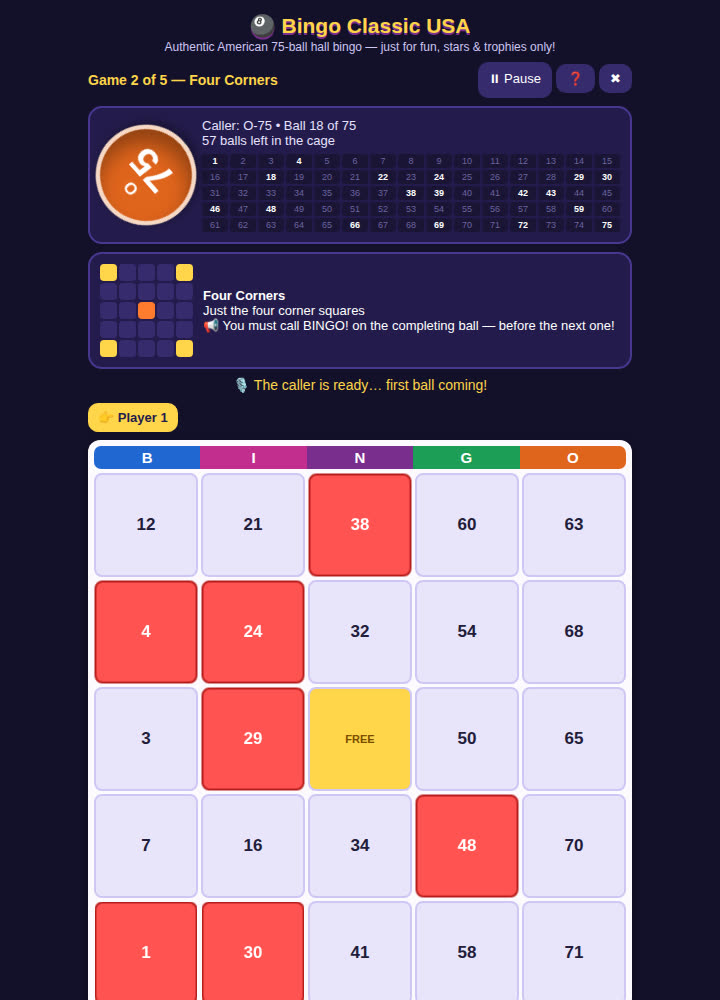
Ball 18 of 75 in Bingo Classic USA — this card is chasing the four corners, with seven numbers already daubed.
Anatomy of a Bingo Card
The card is a 5×5 grid — 25 squares, five columns, and each column belongs to one letter of B-I-N-G-O. This is the part worth memorising, because it tells you where any number lives before you even look:
- B is 1–15, I is 16–30, N is 31–45
- G is 46–60, and O rounds it out at 61–75
So when the caller says "G-52," your eyes should be in the fourth column before the number's even finished. The centre square, by the way, is a FREE space — already yours, no ball required. It's the most valuable real estate on the card, and it's why lines through the middle complete so often.
How a Game Actually Flows
The caller draws balls one at a time and announces them, letter and number. You mark — daub — any square that matches. That's the whole loop, repeated until someone completes the pattern the game is playing for and yells "BINGO!" before the next ball comes out. In a real hall, a claim that's one ball late is worth nothing, which is why experienced players shout first and double-check second.
Playing online softens the sharp edges in a good way. In Bingo Classic USA here on Jollycade, the caller can run at Slow, Normal or Fast, there's an auto-daub setting that marks your card for you (purists turn it off; sensible beginners leave it on for their first games), and computer rivals play alongside you — pick anywhere from a quiet solo hall up to 12 rivals racing you to the shout.
Patterns, From Quick Win to Full Marathon
Not all bingo games ask for the same thing. A single line — any row, column or diagonal — is the sprinter's version and a great first game. Four corners is over before you know it. Two lines stretches things out a bit. And then there's blackout, also called full house or coverall, where every one of your 24 numbers has to come up. Blackout with a full card and two numbers left is some of the cheapest drama in gaming. There are novelty picture patterns too — stamps, kites, letters — but master the line and the blackout and you can sit down anywhere.
Small Habits That Help
Learn the column ranges until they're automatic; it's the single biggest speed upgrade a beginner can make. Pick the pattern in your head before the first ball and keep checking against it, not against some vague hope of "a line somewhere." And when you're one number away — players call it being on the bubble — don't relax. That last number has a cruel sense of timing, and it tends to arrive the second you look at your phone.
One decision you'll meet straight away: how many cards? A single card keeps things calm, and it's the right call while the column ranges are still sinking in. Two to four cards multiplies your chances of being the one who shouts — our hall lets you play up to four at once — but every extra card is another 24 numbers your eyes have to cover. Start with one or two, lean on auto-daub, and add cards only when the pace starts feeling slow.
Ready to try it? A game here takes a few minutes, costs nothing, and needs no download. Eyes down.
Ready to play? Bingo Classic USA is free on Jollycade — no download, no sign-up, just click and play on phone or computer.
▶ Play it free now