🗡️ Demon Blade Hunters Tips: Pick Your Sword Form, Fill Focus & Slay All 24 Demons
A new demon steps out of the dark every night. Twenty-four names wait in the Hunter's Journal, each one waiting to be sketched into it — and you have one sword and three ways to swing it. Demon Blade Hunters is an anime sword fighting game with the soul of the great demon-slayer stories: the night, the blade, the breathing, and the boss that is always just a little bit stronger than you were last time.
The controls are simple enough to learn in a minute — tap the right side of the screen or press Space to slash, tap the left side or Shift to dash — but the game underneath is all about choices. Which sword form do you fight in? When do you spend your Focus? Do you chase the strange little wisp drifting across the arena, or ignore it and finish the demon? Every night asks you these questions again, and the hunters who answer them well are the ones who fill the journal. Here's how.
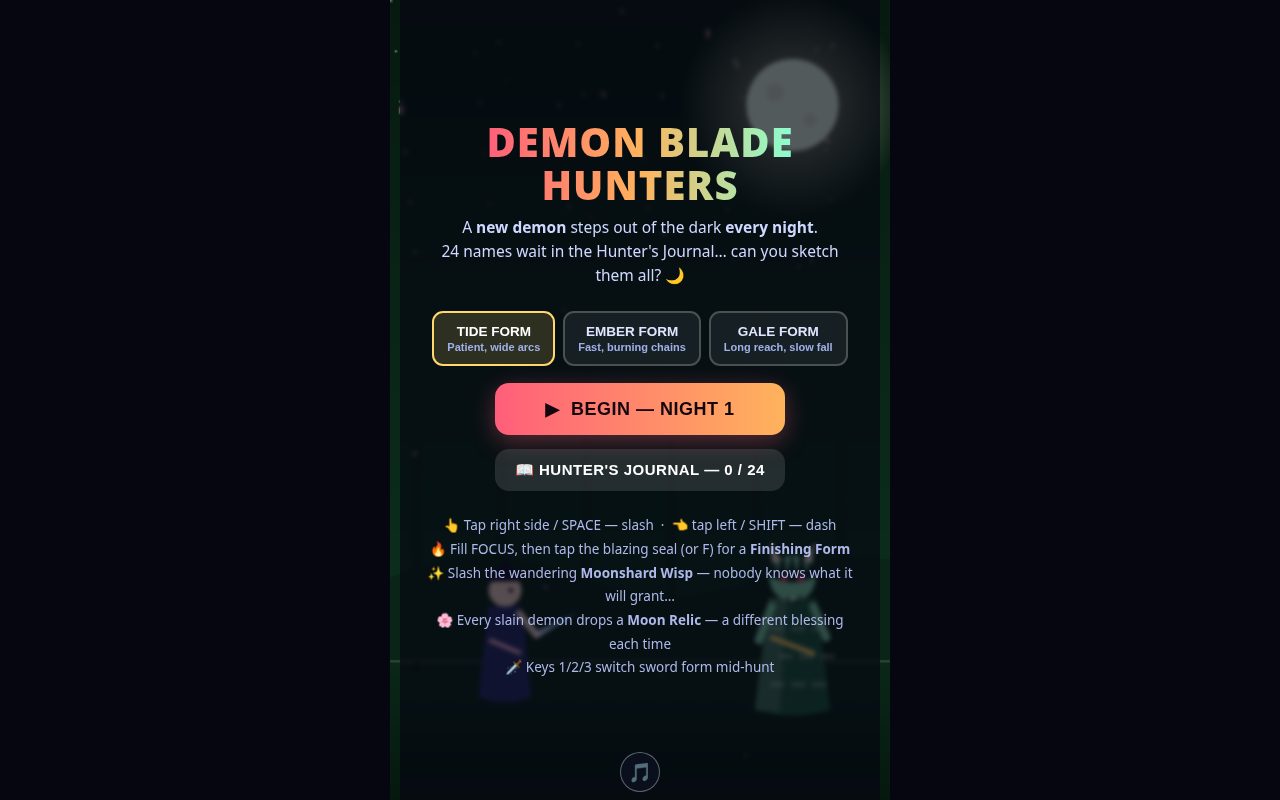
Fresh screenshot from our own game — Demon Blade Hunters. Three sword forms, 24 demons, and a new one every night.
Your sword form is your whole strategy
Before Night 1 even begins, the game asks you to choose: Tide, Ember, or Gale. This is not a cosmetic choice — it's your whole fighting style. Tide is patient, with wide arcs that catch demons trying to slip past you. Ember is fast, with burning chains of quick slashes for hunters who stay on the attack. Gale has the longest reach but swings slowly, rewarding hunters who keep their distance and punish from range.
For your first nights, start with Tide. The wide arcs forgive sloppy timing, and when a demon lunges, a wide arc is the swing most likely to connect. Once you've survived a few nights and you understand how demons move, try Ember for the nights when you want to press the attack, and Gale for the big, slow demons where reach matters more than speed. And you can switch forms mid-hunt with keys 1, 2 and 3 — start in Tide, switch to Ember when the demon staggers, and finish the job before it recovers.
Dash more than you slash
The biggest beginner mistake in any sword game is swinging too much. Every slash leaves you standing still for a moment, and demons are very good at punishing a hunter who stands still. The dash is your best friend: it gets you out of a lunge, repositions you behind a demon, and buys you the half-second you need to think. Watch the demon, not your own blade — when it winds up, dash; when it recovers, slash.
That rhythm — dash, watch, slash, dash — is the whole combat loop, and it works on every demon in the journal. The ones that look impossible on Night 1 are usually just demons whose rhythm you haven't learned yet. Give yourself one scouting attempt per demon — just dash, watch when it lunges and when it rests. The second attempt is always easier, because now you're fighting a pattern instead of a surprise.
Don't waste the Finishing Form
As you land hits, your Focus fills. When it's full, the blazing seal appears — tap it, or press F, and you unleash the Finishing Form, the biggest damage in the game. The temptation is to fire it the instant it's ready, and that's almost always wrong — a Finishing Form spent on a demon that's about to dash away is a Finishing Form wasted.
Wait for the opening instead: right after the demon finishes a big lunge, when it's recovering and can't move. That's when the seal is worth its weight in gold. And if the demon is nearly dead anyway, save the Focus — the next night starts with whatever you didn't spend. Patience with the big button is what separates hunters who clear nights from hunters who keep dying at the last sliver of health.
Chase the wisp, collect the relics
Two small things make a big difference over a long hunt. First, the Moonshard Wisp: a little glowing spirit that wanders across the arena mid-fight, and nobody knows what it grants until you slash it. Always chase it. Whatever it gives you, it's free, and free things in a boss fight are worth a small risk. Just don't chase it through a demon's lunge; wait for the safe moment, then take it.
Second, the Moon Relics. Every demon you slay drops one, and every relic is a different blessing — a small, permanent-feeling edge that stacks up night after night. That's why the journal matters: it's a record of 24 relics earned, 24 nights survived. The hunter who has slain ten demons is genuinely stronger than the one who has slain two — not because of levels, but because of everything those ten nights taught them.
Your hunter's checklist
- Start with Tide form — wide arcs forgive sloppy timing; switch with keys 1/2/3 mid-hunt when the moment calls for it.
- Dash first, slash second — dodge the lunge, then punish the recovery; never stand still after a swing.
- Learn the pattern before you try to win — one scouting attempt per demon makes the real attempt far easier.
- Save the Finishing Form for the recovery window — fire the blazing seal when the demon can't move, not the instant it's ready.
- Always chase the Moonshard Wisp — its gift is free and it changes every time; just wait for the safe moment.
- Collect every Moon Relic — each slain demon drops a different blessing, and the journal is your real progress.
- One demon per night is enough — 24 nights, 24 names; the journal fills one hunt at a time.
Demon Blade Hunters is a game about patience disguised as a game about swords: pick the right form, dash more than you slash, and save your biggest move for the moment it can't miss. The journal has 24 names in it, and every one of them can be yours. More guides live on the Jollycade blog, and the homepage has the rest of the arcade waiting.
Ready to play? Demon Blade Hunters is free on Jollycade — no download, no sign-up, just click and play on phone or computer.
▶ Play it free now